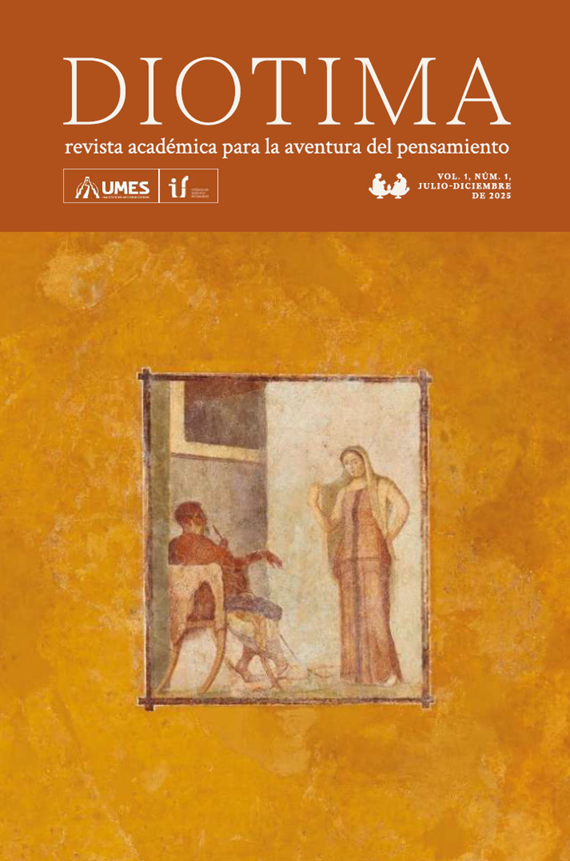
Diotima de Mantinea, maestra-sabia y partera en la contemplación del Eros (Amor): alcances histórico-filosóficos desde El Banquete de Platón
Palabras clave:
amor, Eros, mujer, sabiduría, dianoia, noesis, contemplación, virtud, mayéutica, maestraResumen
La historia de la filosofía no siempre ha dado importancia a la impronta que ha tenido la mujer en la construcción de la cultura. Esto ocurre con más incidencia en la Edad Antigua y la Edad Media; una afirmación que no libra a la Edad Moderna de este desplazamiento. Sin embargo, Platón, en su obra El Banquete o Simposio, hace una excepción cuando discurre sobre la esencia del Eros (Amor). Será una mujer —Diotima de Mantinea— quien instruye a Sócrates en un camino mayéutico para que este pueda comprender y contemplar el Eros como arquetipo perteneciente al mundo eidético. Diotima será maestra-sabia que develará este misterio al discípulo; lo llevará por elevación y purificación a una contemplación metafísica del misterio del Amor. Y, aunque siga en juego la incógnita sobre la existencia histórico-geográfica de esta maestra-sabia, pesa más la incidencia filosófica que Platón le atribuye en el diálogo establecido con Sócrates. Este escrito permitirá al lector concluir que, la construcción del conocimiento filosófico y otras áreas de la cultura, como la ciencia, el arte, las humanidades, la tecnología, entre otros, no son quehacer exclusivo de hombres, sino un horizonte abierto para todo aquel que quiera profundizar con rigor y seriedad en el misterio del Ser.
Descargas
Referencias
Aristides, Aelius. Orations, vol. II, editado y traducido por Michael Trapp. Loeb Classical Library.
De Alejandría, Clemente. Stromata, Libro IV, cap. 3, fragmento 31.4. Internet Archive.
Fougeres, Gustave G. Mantinée et L’arcadie orientale, editado por Alvert Fontemoing. Paris: Ancienne Librairie Thorin et Fils, 1898.
Gleichauf, Ingeborg. Mujeres Filósofas en la historia. Barcelona: La Desclosa, S. L., 2010.
Homero, Ilíada. Madrid: Gredos, 1996.
De Tiro, Máximo. Disertaciones Filosóficas XVIII-XLI, parte XVIII, sección 4. Madrid: Gredos, 2005.
Ménage, Gilles. Historia de las mujeres filósofas. Barcelona: Herder, 2009.
Platón. El Banquete, versión de Juan David Bacca García. México: Universidad Nacional Autónoma de México, 1944.
—. El Banquete. Introducción, traducción y notas de M. Martínez Hernández. Madrid: Gredos, 1968.
Samósata, Luciano de. El Eunuco. en Obras, vol. 3, traducción de Juan Zaragoza. Madrid: Biblioteca Clásica Gredos, 1990.
Ugalde Quintana, Jeannet. «Diótima, Maestra de Sócrates en el conocimiento del amor, su presencia en el diálogo Simposio». Aporía, Revista Internacional de Investigaciones Filosóficas, n.o 25 (2023).