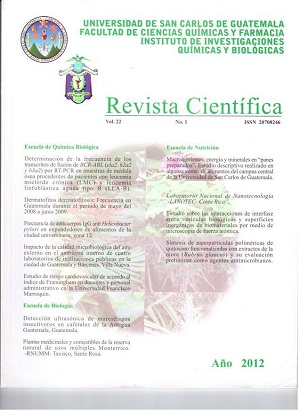
Study of cardiovascular risk according to the Framingham index of faculty and staff at the University Francisco Marroquin.
Keywords:
cardiovascular risk, Index of Framingham, total cholesterol, triglyceridosAbstract
Study of cardiovascular risk according to the Framingham index of faculty and staff atthe University Francisco Marroquín.
Abstract
The faculty and staff of an academic institution should keep good health to meet the daily challenges of theirwork mainly in terms of their cardiovascular health.Is important for patient at risk to know his cardiovascularand coronary disease assessment in order to dicede preventive strategies. We investigated the relationshipbetween age, waist circumference, weight, fat percentage, BMI, physical activity, smoking, total cholesterol,HDL, LDL, triglycerides and glucose and its relation to cardiovascular risk. The sample consisted of 40 adultsover 20 years of both sexes whose profile is the intellectual worker, sedentary and subjected to stress. Theresults were compared to the Framingham Index a multifactorial test. It showed the range where the highestvalue of 21.32% of cardiovascular risk, overlaps with the patient's age and not with the other parametersstudied, also established a significant relationship between high systolic pressure and waist circumferencehigh of 11.91%. The values of 7.14%, 7.73% and 12.10% are mainly cardiovascular risk associated withsmoking.
Key words:
Cardiovascular risk, Index of Framingham, total cholesterol, triglyceridos.
References
Referencias
Brindle, P., Emberson, J., Lampe, F., Walker, M.,
Whincup, P., Fahey, T y Ebrahim, S. (2003, Nov).
Predictive accuracy of the Framingham coronary
risk score in British men: prospective cohort study.
BMJ, 29(327), 1267.
D’Agostino, RB., Grundy, S., Sullivan, L y Wilson,
P. (2001). Validation of the Framingham coronary
heart disease prediction scores: results of a multiple
ethnic groups investigation. The Journal of The
American Medical. JAMA 11; 286(2):180.
Ford, E., Giles, W y Mokdad, A. (2004).The
distribution of 10-Year risk for coronary heart disease
among US adults: findings from the National Health
and Nutrition Examination Survey III. Journal of
The American College of Cardiology, 43:1791.
Wilson, P. (2010). Estimation of cardiovascular risk
in an individual patient without known cardiovascular
disease. Editor Gordon M Saperia, MD, FACC
version 18.1
Vasan, R., Pencina, M y Cobain, M. (2005). Estimated
risks for developing obesity in the Framingham
Heart Study. Annals of Internal Medicine, 143:473.
Villagran, F., Wunderlich, P., Menendez, F., Blanco,
R. & Velasco, R. (2011) Circunferencia abdominal
y la presencia de factores de riesgo cardiovascular
en niños con obesidad esencial. Revista Facultad de
Medicina UFM.
Wilson, P. (1944) Established risk factors and
coronary artery disease: The Framingham Study.
American Journals of Hypertension, 7:7S.
Wilson, P., D’Agostino, R., Levy, D., Belanger, A.,
Silbershatz, H y Kannel, W. (1998). Prediction of
coronary heart disease using risk factor categories.
AU Circulation, 12;97(18):1837-47.
Yusuf, S., Hawken, S, y Ounpuu, S.(2004). Effect
of potentially modifiable risk factors associated with
myocardial infarction in 52 countries (the
INTERHEART study): case-control study. Lancet ,
:937.